
14 January 2012. It was winter. The evening of was cold and foggy. Darkness had already settled over the remote Sundarbans
landscape of Khulna when, at around 8:00 p.m., an urgent message reached Mr.
Zahir Uddin Ahmed, Divisional Forest Officer (DFO), Sundarbans West Forest
Division that a Royal Bengal Tiger had strayed out of the Sundarbans. The wild animal
had entered the homestead of Mr. Md. Sujauddin, aged about 30, son of Mr. Intaj
Mollah, at Angtihara village under Dakshin Betkashi Union of Koyra Upazila,
Khulna District. It had finally taken shelter inside a simple kachcha
house standing close to the Shakbaria River. The DFO immediately informed me
and instructed me to take all necessary action.
I immediately mobilized Forest Department personnel from Bozboza and
Khashitana Camps and Kashiabad Station and directed them to rush to the site.
My initial instruction was to secure three sides of the house with strong nets
while leaving the river-facing side open. The idea was simple: if the tiger
could be encouraged to leave the house, blank shots from Forest Guards might
guide it safely towards the river and, eventually, back into the forest. But
nature and the tiger had arranged things differently.
By then, news of the tiger's arrival had spread rapidly through the
locality. Alhaj Abdul Mannan, the local Union Parishad Chairman, members of the
police, journalists and local residents had gathered around the area. Curiosity
was high, but so was the danger. Soon the Station Officer of Kashiabad informed
me of an important problem. The door of the house faced the village, not the
river. It was therefore impossible to create the safe passage we had originally
planned. Any attempt to drive the tiger out could send it directly towards the
settlement. The situation had suddenly become far more serious.
I contacted the DFO again. He was then staying in Khulna, nearly 80
kilometres away, and I requested the immediate deployment of the Tiger Response
Team. Without delay, the DFO sent a team led by Mr. Monaem Hosen forester, from
Koikhali Station under Satkhira Range. The team reached the site at around
11:00 p.m. Meanwhile, at about 10:00 p.m., I had also discussed the situation
with the Programme Officer of the Sundarbans Tiger Project under WTB and
requested that a complete tiger-tranquillization set and other necessary
equipment be arranged. By this time, the DFO decided that he would personally
travel to the site that very night.
It was an exceptionally cold and foggy winter night, and travelling
through the rivers of the Sundarbans by speedboat under such conditions was
extremely risky. Visibility was poor, the waterways were dark, and navigation
through the intricate river channels demanded great caution. Yet the urgency of
protecting both the tiger and the people left little choice.
At around 11:30 p.m., the DFO left Khulna by speedboat, carrying the
tranquillization equipment and necessary protective gear. Deep into the night,
the boat moved through the mist-covered waterways. At approximately 3:30 a.m.
on 15 January, he reached Nalian Range Headquarters, where I was waiting for
him. I joined him, and together we continued towards the village. Meanwhile,
the Tiger Response Team had successfully surrounded the house with nets and
maintained continuous surveillance throughout the night. Forest staff, the
Union Parishad Chairman and a few local residents remained nearby, keeping
watch in the cold darkness.
As dawn slowly emerged through the winter fog, we carefully looked
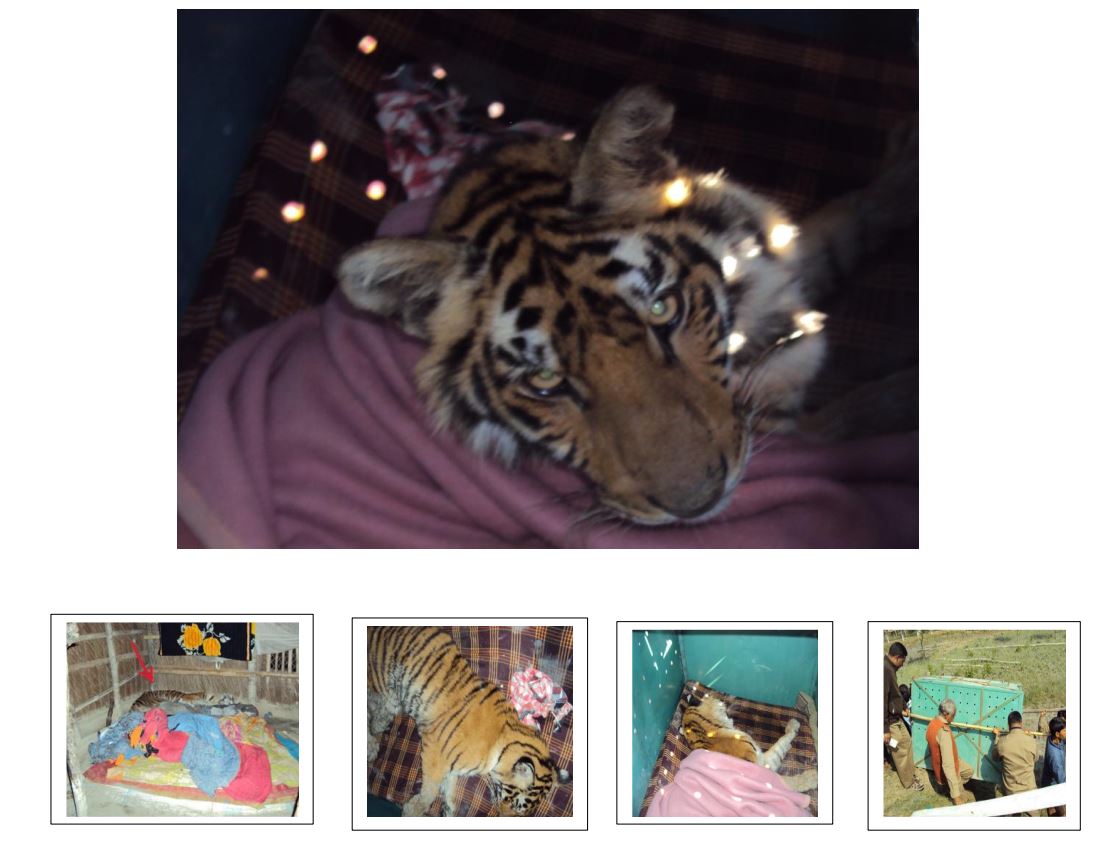
through a gap in the house's golpata fence. We found that, the tigress
that had created such anxiety throughout the night was lying peacefully inside
the house. Far from showing aggression, she appeared astonishingly calm. Beside
a blanket and pillow laid on a bed on the floor, this magnificent creature of
the Sundarbans was sleeping comfortably as though, for a few hours, she had
simply borrowed a villager's home as her winter shelter. At around 6:30 a.m.,
Mr. Abu Naser Mohsin Hossain, ACF, who had accompanied the DFO, carefully took
position. With remarkable skill and precision, he successfully tranquillized
the tigress. With this the most critical stage of the operation was over. Once
the animal was fully sedated, we safely removed her from the house and
transported her by speedboat to Kalagachhia Camp. There, a veterinary surgeon
examined her carefully, and Forest Department officials together with WTB
members provided the necessary post-tranquillization treatment. During the
examination, we discovered something that explained much about her condition. She
stood a young tigress, estimated to be only about six years old, but part of
her right hind leg below the knee was missing. From external observation, it
appeared that the injury had occurred when she was perhaps only one or two
years old. Her measurements were also recorded while she remained under
sedation. She measured approximately 7 feet 6 inches in total length, including
a 2 feet 6-inch tail, and weighed about 75 kilograms. Despite her disability,
she was an impressive and beautiful animal.
After about four hours, the tigress gradually recovered from the effects
of the tranquilizer. Before regaining full consciousness, she had been safely
transferred into a tiger cage. After that our this unusual guest was served
breakfast. Mr. Md. Towfiqul Islam, ACF and officer-in-charge of Satkhira Range,
had arranged a generous meal for her five large country chickens along with
beef and other food. Surprisingly within only a few minutes, most of the food
had disappeared.
Then the question appeared- Should she be released back into the
Sundarbans? Under normal circumstances, returning a rescued tiger to its
natural habitat would have been the preferred choice. But her case was
different. She was still young, yet permanently disabled. With a significant
portion of one hind leg missing, her ability to hunt successfully, defend
herself, compete with other tigers and survive independently in the demanding
environment of the Sundarbans was highly uncertain. After careful
consideration, it was decided that releasing her back into the wild could place
her life at greater risk. Therefore, at around 12:30 p.m. the rescued tigress
began another journey towards the rescue facilities at Dulahazara Safari Park,
Cox's Bazar, where she could remain under appropriate care. As her vehicle
departed, the long hours of anxiety finally gave way to a deep sense of relief
and satisfaction.
The operation was not merely a rescue of a tiger, but as an example of
what can be achieved when institutions and communities work together. The
successful operation became possible through the coordinated efforts of the
Bangladesh Forest Department, WTB, the Police Department, the Tiger Response
Team, local administration and, most importantly, the people of Dakshin
Betkashi Union. For those of us who served in the Sundarbans, such events were
more than official duties. They were reminders of the enormous responsibility
entrusted to us- the responsibility of protecting human lives while, at the
same time, safeguarding one of the world's most magnificent wild animals and
the extraordinary forest it calls home.
Last but not the least, the Royal Bengal Tiger and the people living
beside the Sundarbans do not have to be enemies. With preparedness, compassion,
scientific management and community cooperation, coexistence is possible.
It remains one of the most
unforgettable moments of my professional life.
The writer, Dr. Mohammad Zahirul Haque, was serving at the time as
Assistant Conservator of Forests (ACF) and Range Officer, Khulna Range,
Sundarbans West Forest Division, Khulna, Bangladesh.
Share this page via
More from Dr. Mohammad Zahirul Haque